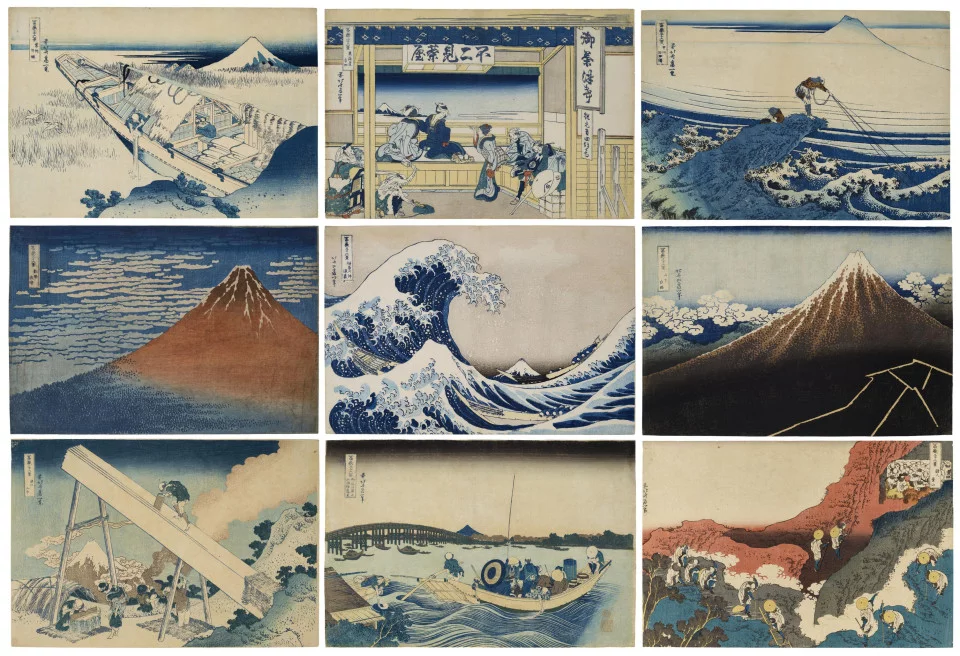
On dit que l’un des premiers artistes à avoir travaillé en série, ce serait Claude Monet avec sa célébrissime série sur les nymphéas. En tout cas, j’ai trouvé cette affirmation lors d’une exposition à Giverny, justement consacrée à Monet et Rothko. Je pense toutefois qu’on peut trouver un certain nombre de contre-exemples ; je pense par exemple aux 36 vues du mont Fuji réalisées par Hokusai. C’est un peu curieux comme affirmation, sachant que Monet était lui-même assez admirateur de Hokusai — mais pas seulement de lui —, des estampes japonaises en général. D’ailleurs, quand on visite sa maison à Giverny, on y trouve de nombreux exemples.
Pourquoi les artistes travaillent-ils en série ?___
En général, c’est pour s’intéresser à un sujet, une problématique donnée. Chez Monet, le sujet ce sont les nymphéas ; chez Hokusai, c’est le mont Fuji. Je ne fais pas exception à cette règle : de mon côté, c’est l’étude d’un nouveau matériau.
La série, c’est donc un ensemble d’œuvres traversé par le même sujet. C’est exactement pareil en musique : on appelle ça un album. Dans un album, on sent bien qu’il y a une unité commune à tous les titres, quelque chose qui les rassemble. Cela dénote un caractère important de la série : la notion de cohérence. Toutes les œuvres d’une série sont cohérentes entre elles, en tout cas d’un point de vue esthétique.
Sélection___
D’ailleurs, quand j’ai constitué la série Luminotype, j’ai écarté les peintures qui s’éloignaient trop de cette unité que j’avais en tête. Parfois le souci résidait dans l’aboutissement de l’œuvre considérée. Il se peut aussi que la toile en question était trop différente et qu’elle valait sa propre série — dans le sens où sa singularité pouvait constituer une série à part entière.
J’aime cette notion de série car elle donne un cadre, permet de cibler une question donnée, et nécessite de créer une esthétique au service de notre objet d’étude. Cela pousse à réfléchir de façon formelle à comment concevoir, rassembler et articuler les éléments qui forment notre série.
Je vous ai fait part ici de la vision du créateur, de l’artiste. Du côté du regardeur, la cohérence devrait s’imposer d’elle-même : la série, pour exister pleinement, doit être perceptible comme telle sans qu’on ait besoin de l’expliquer.
La contrainte est fertile___
En tout cas, il est certain que la contrainte dans laquelle on se place est motrice de créativité. La contrainte est fertile. D’une certaine façon, c’est le resserrement qui ouvre. Pour reformuler, je poserai la question suivante : en respectant les contraintes que l’on s’impose, comment inventer, décliner, éclairer, nourrir, approfondir notre sujet et lui apporter la lumière nécessaire ?