I am pleased to present a very nice article in the IAM magazine. The latter is a quality review specialized in quarterly publishing art. I was interviewed by the editor Dominique Lecat, who fully embraced the stakes of the practice that I am developing. A few years away, it was a coincidence that we went through the same engineering school, there are also happy encounters.
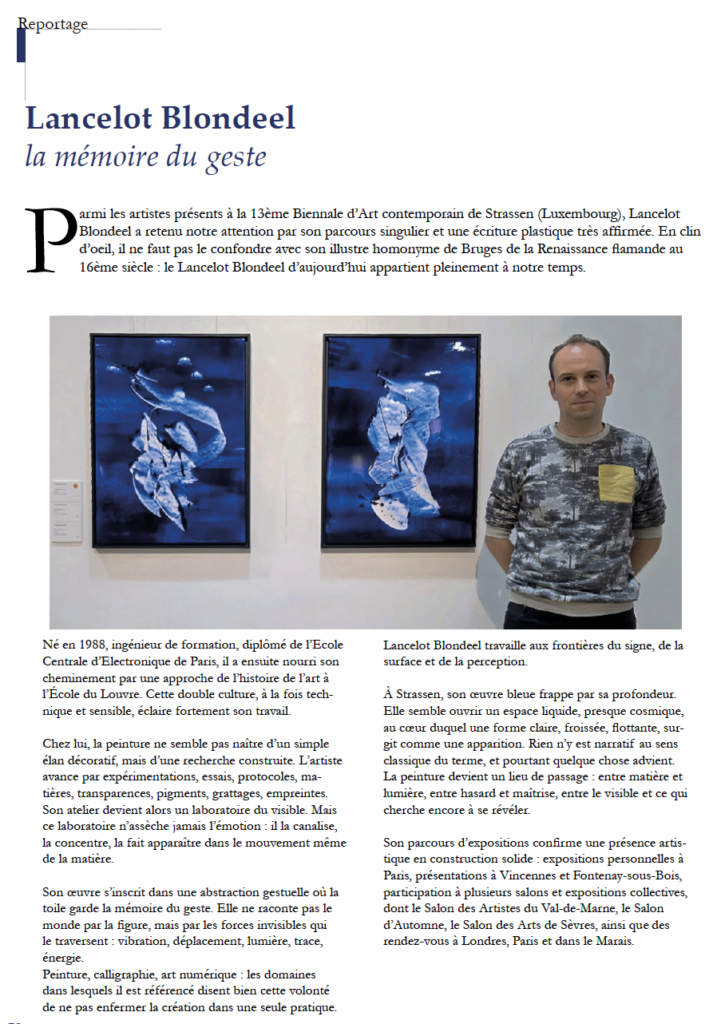
Transcription of the article
Among the artists present at the 13th Biennale d'Art Contemporain de Strassen (Luxembourg), Lancelot Blondeel has caught our attention by his singular journey and a very strong plastic writing. In the blink of an eye, it should not be confused with its illustrious homonym of Bruges of the Flemish Renaissance in the 16th century: Lancelot Blondeel today belongs fully to our time.
Born in 1988, a training engineer, a graduate of the Ecole Centrale d'Electronics in Paris, he then fed his journey through an approach to art history at the École du Louvre. This dual culture, both technical and sensitive, greatly illuminates his work.
In him, painting does not seem to be born of a simple decorative impulse, but of a built-up research. The artist advances through experiments, trials, protocols, materials, transparencys, pigments, scrapings, prints. His workshop then becomes a laboratory of visible. But
This laboratory never dries emotion: it channels it, concentrates it, makes it appear in the very movement of matter.
His work is part of a gestureal abstraction where the canvas keeps the memory of the gesture. It does not tell the world by the figure, but by the invisible forces that pass through it: vibration, displacement, light, trace, energy.
Painting, calligraphy, digital art: the fields in which it is referenced well indicate this desire not to lock creation in a single practice. Lancelot Blondeel works at the borders of sign, surface and perception.
In Strassen, his blue work struck by its depth. It seems to open up a liquid space, almost cosmic, at the heart of which a clear, cracked, floating form emerges as an apparition. Nothing is narrative in the classical sense of the term, and yet something happens.
Painting becomes a place of passage: between matter and light, between chance and mastery, between the visible and what still seeks to reveal itself.
Its exhibition course confirms a strong artistic presence in construction: personal exhibitions in Paris, presentations in Vincennes and Fontenay-sous-Bois, participation in several collective exhibitions and exhibitions, including the Salon des Artistes du Val-de-Marne, the Salon d'Automne, the Salon des Arts de Sèvres, and meetings in London, Paris and the Marais.
His work has also been publicly acquired by the Artothèque Paris Est Marne & Bois, and is already circulating in private collections in France, the United States, Luxembourg and Italy.
In the context of the Strassen Biennale and the 175 theme, Lancelot Blondeel provides a different response from that of artists working in the figure or history. He does not attempt to illustrate the number, but to make the underlying forces feel: the passage of time, flows, ruptures, recompositions, metamorphoses.
Where some artists raise human characters, dates or memories, they question the very transformation of the real through matter, gesture and light.
This is probably where the interest of his work lies: in this ability to unite rigour and freedom, method and intuition, science of the process and abandonment to the pictorial surge. Lancelot Blondeel paints less what we see than what works silently the visible. His painting does not close his eyes; She opens it.
Dominique Lecat
Editor IAM magazine